
.png)
Artificial intelligence is no longer a future topic for the defence sector—it is a defining force of the present. This was the central message of the panel discussion “AI in Defence” at the AI Horizons event on November 27, 2025, in Frankfurt. Bringing together perspectives from industry, academia, venture capital and software, the panel offered a 360-degree view on how AI is reshaping security, technology, and European sovereignty.
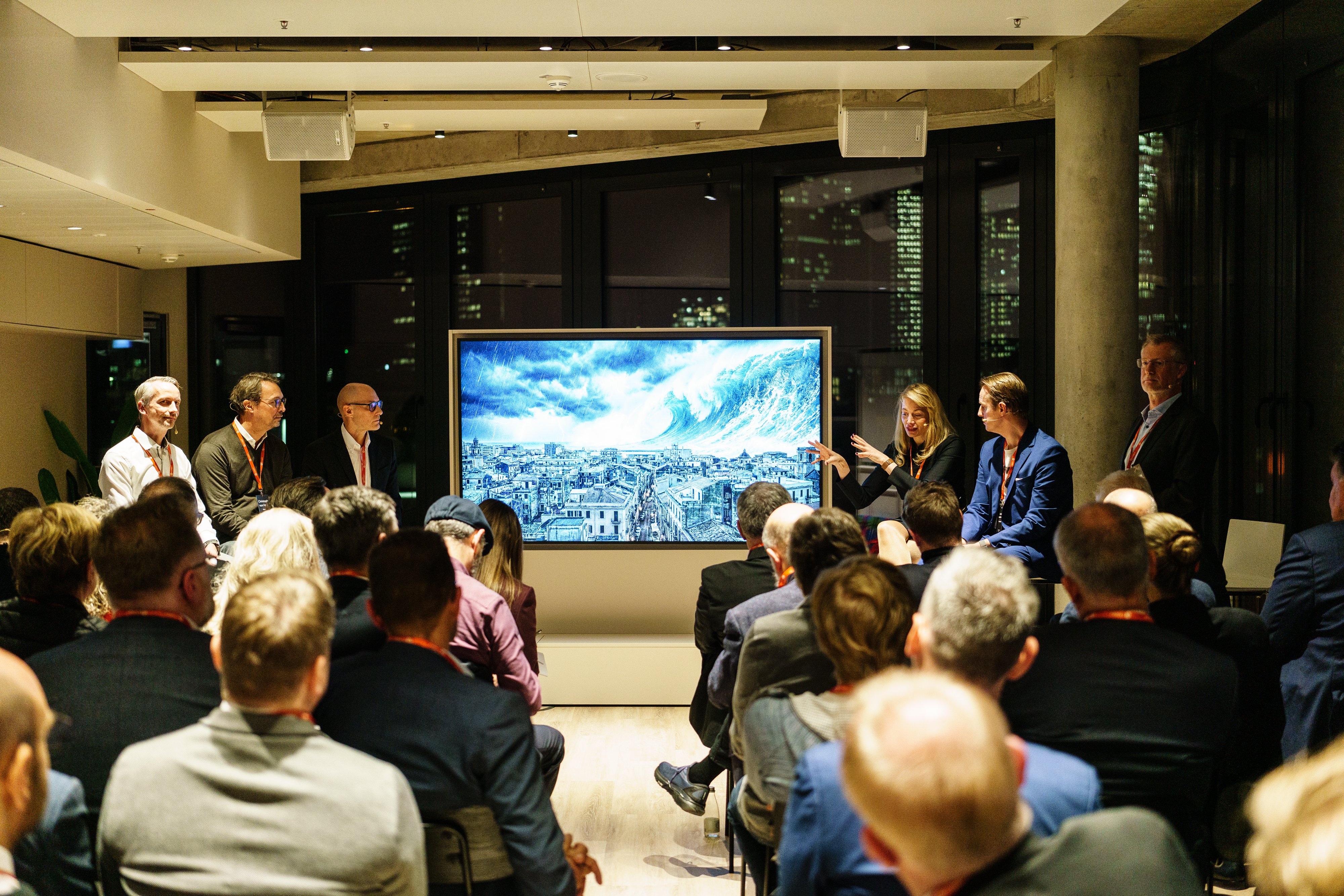
Moderated by Gebhard Proske, the discussion featured Mirko Reuter (Airbus Defence and Space), Stephanie Wißmann (University of the Bundeswehr), André Scheidhammer (Hensoldt), Bernd Hellinger (USU Solutions), and Christoph von Falck (Helantic). Together, they explored how geopolitical pressure, technological acceleration, and regulatory complexity are converging into what many described as a historic inflection point.
The backdrop of the discussion was unmistakable: the war in Ukraine, rising geopolitical tensions, and growing awareness of Europe’s digital dependencies. Rather than treating the situation purely as a crisis, the panel framed it as a catalyst for long-overdue transformation. Defence, once considered slow-moving and hardware-centric, is rapidly becoming software-driven, data-centric, and highly adaptive.
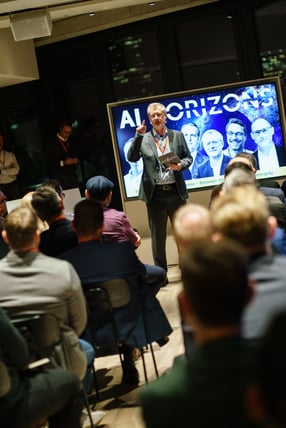 AI was described not as a hype, but as an operational necessity—already embedded in sensor fusion, situational awareness, cyber defence, and autonomous systems. The speed at which systems can learn, adapt, and be redeployed is now a decisive factor, both on the battlefield and in industrial competitiveness.
A recurring theme was the shift toward software-defined defence. Traditional boundaries between internal IT, product development, and operational systems are dissolving. AI plays a central role across the entire lifecycle—from development and testing to deployment and continuous learning in real-world operations.
Closely linked to this is the concept of multi-domain operations, integrating land, air, sea, space, and cyber domains, while increasingly involving civilian infrastructure and industry. The challenge is no longer the lack of data, but the ability to integrate, secure, and interpret massive volumes of heterogeneous information in real time.
Beyond technology, the panel highlighted digital and technological sovereignty as a strategic priority for Europe. Dependence on non-European hyperscalers, cloud platforms, and cybersecurity solutions is increasingly seen as a vulnerability—not only for defence organizations, but for society at large.
At the same time, strict regulations around classified and sensitive data pose real challenges for innovation, particularly when AI workloads must run on-premises rather than in scalable cloud environments. The discussion made clear that sovereignty and innovation are not opposites, but they require new architectures, new partnerships, and better coordination between regulatory bodies.
One of the strongest signals from the panel was the need for closer collaboration: between startups and large defence companies, between industry and academia, and between public institutions and private capital. Defence-focused venture capital, once unthinkable, is now emerging as a key driver for innovation, especially in areas such as space-based intelligence, cyber defence, drone and counter-drone technologies, and AI-driven surveillance.
 The panel also emphasized that many defence innovations are inherently dual-use and can generate broader societal value—echoing historical patterns where military research has fueled civilian breakthroughs.
Finally, the discussion acknowledged the accelerating pace of AI development. Linear planning models are no longer sufficient in a world where capabilities evolve weekly rather than yearly. Staying competitive requires openness, diversity of partners, and the willingness to rethink established processes.
The evening concluded with a clear takeaway: AI in defence is not just about technology—it is about mindset, speed, and responsibility. Making AI work for organizations, rather than the other way around, will be critical as Europe navigates the balance between innovation, security, and sovereignty.

.png?width=800&height=148&name=DEWhat%E2%80%99s%20next%20(3).png)
.png)
-2.png)